Two Truths and a Lie
Have you ever played the party game Two Truths and a Lie? Let's play now.
Pick out the lie.
The science of reading has given us real, replicable answers about how children learn to read and write.
Literacy is inseparable from meaning, culture, and belonging. Children should be active participants in a rich learning environment.
You have to pick one of the above and defend it against the other.
If you work in NZ education, you may already know which one's the lie, but you may also feel pushed to sit on one side of the room or the other. That's the problem I want to talk about.
The iceberg
Dr Rosemary Hipkins spoke at the Learning Disabilities Association of New Zealand’s mini conference on the 4th of April and presented an image I’ve found myself turning over ever since: an iceberg. Above the waterline sits behaviour, the small, visible part of a child’s learning that we can see and measure: what they read aloud, what they write, and how efficiently they engage with text. Below the waterline, far bigger and mostly unseen, sit constructivism, the socio-cultural, and complexity: the meaning-making, the relationships, the culture a child is learning inside of.
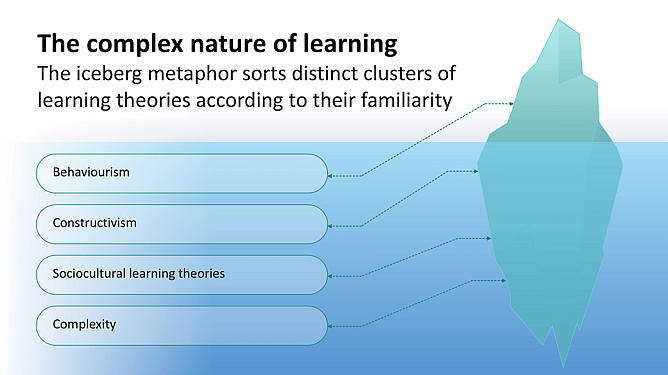
Source: Hipkins, R. (2026). “The complex nature of learning,” Slide 8, in Reframing learning, reading, and dyslexia as complex phenomena. Presented at the LDANZ Mini Conference, 4 April 2026.
Back to our game. The two truths roughly sort into two camps: the above-the-waterline camp and the below-the-waterline camp. My position is that both parts of that iceberg are valid. One is simply much easier to see than the other.
The above-the-waterline camp treats reading as a measurable skill built from parts, with clear cause-and-effect. To make the invisible process of reading visible, researchers have offered frameworks such as the Simple View of Reading (Gough & Tunmer, 1986) and Scarborough’s Reading Rope (Scarborough, 2001. Over decades, many scientific disciplines converged to offer insight into something remarkable: humans take spoken language, a skill the brain is wired for, and repurpose it for reading and writing, which human brains were not built for. That same research, which we have come to call The Science of Reading, has also shown how to make word reading happen reliably, for nearly everyone.
The below-the-waterline camp treats reading as a component of literacy learning. And learning is a natural process that happens in relationship: a child, a culture, a classroom, a story, all shaping each other. Meaning, motivation, identity, and belonging are not decorative extras bolted onto “real” learning. They are how learning happens. The process is complex and cannot be broken into distinct parts that are easy to measure.
I argue both of the camps speak truth. The lie is that you have to choose.
What gets lost in the choosing
Both camps, at their best, are trying to protect something real. A child’s wellbeing genuinely suffers without basic literacy — that’s not negotiable. Science has earned the right to say basic literacy is achievable through tried-and-true methods. But literacy was never only about efficient word recognition: it’s also meant to build the thinking, identity, collaboration, and problem-solving that the next generation will need far more of than we did. A classroom that nails the mechanics of reading but starves a child’s curiosity has still failed them. So has a classroom that nourishes curiosity while a child quietly falls further behind on the actual words on the page.
This is an abstract argument for me. It’s my own life.
The Bluejays
In 1988, I was diagnosed with dyslexia* at seven in the United States. The primary school I attended had, with real warmth, embraced whole language completely. We were read to every day. We sat in circles and sang songs. There was a doll corner, a block corner and a swing set outside. I loved those early years. I want to be clear about that before I say the next part.
I was also in the Bluejays.
The Bluejays were my reading group, and we started with six kids. Over that year, the group got smaller and smaller, as one by one the others figured out how reading worked and moved on to new books. I did not. I knew some words like "the " and "dog" but the letters themselves felt like a puzzle with no floor under it. The words sit and sat looked and sounded almost the same but meant different things, and I could not, for the life of me, work out why. So I gave up trying to solve the puzzle.
I learned to recognise whole words by their shape, by where they sat on a page, by what picture was next to them. It worked, for a while. It worked right up until the books stopped having pictures. Then, all at once, the words I’d been carrying around in my head (school, dad, play, ball) became slippery again, and the books got too hard all over again. That’s the above-the-waterline stuff, right there. A real, specific, measurable difficulty with reading words. And week after week, I sat in a reading group and did not learn how to read.
Yet here’s the other half of it. My school read to me beautiful books nearly every day. A few years later, in fifth grade, my teacher, Mrs Reed, read Where the Red Fern Grows aloud to the whole class. It’s a story about a boy and his two hunting dogs, and at the end, the dogs die, and the entire class cries. I cried. And it was the first time I remember realising that I loved novels, even if I could not read one myself.
I could not have told you, at ten years old, that I needed both. I needed the code: the explicit, patient, unglamorous work on the mechanics of print. And I needed the story, read aloud, that gave me a reason to want to be a reader at all. The story made me want to read more books about dogs I didn't have and places I'd never been. I needed both, but the Bluejay classroom and my lovely, warm teachers had only the tools of the whole-language camp. They didn't know how to teach the code, so I couldn’t read the stories.
The answer
So here's the reveal. Truth one: the above-the-waterline camp is real, and it matters enormously. Truth two: the below-the-waterline camp is real, and it matters just as much. The lie? That a teacher, a school, or a professional body has to pick one. A child is never just a decoding problem or just a meaning-maker. She's both, at once.
What does that look like in practice?
At the Global Perspectives on Literacy conference in Christchurch this March, Maggie Snowling described the answer as a sandwich: Read, Code, Read. She was referring to a specific intervention programme, but I think the metaphor holds for reading instruction more broadly.
Read to the child from real, rich literature. Teach the code explicitly so they can read and spell accurately. Then have them read.
Leave out the code, and it's just pieces of bread. This is what happened to me. The Bluejays gave me all the bread anyone could ask for: stories, warmth, a teacher who cared. What I never got was any substance in my sandwich. No one at my school knew how to teach me the code; they lacked the tools developed by the above-the-line camp. As a result, it took me years of embarrassment and struggle to learn to read on my own, and I still find it challenging to complete simple everyday tasks, like writing a greeting card or filling out a handwritten application.
On the other hand, leave out the story, and you're left with just the filling: a pile of spelling rules and no sense of why any of it matters.
This isn't just one child's story. A major reanalysis of national reading data found that the benefit of phonics teaching nearly tripled when it was taught alongside rich language instruction, rather than alone. Read. Code. Read. Miss any one of the three, and a child pays for it.
Back to the Two Truths and a Lie, I framed this as a game, but there are serious consequences to believing the lie. Children need educators who can hold two truths with open hands and reject the false choice between science and complexity.
By Joann Bevens, M.S. Special Education, Chairperson, Learning Disabilities Association of New Zealand
References
Gough, P. B., & Tunmer, W. E. (1986). Decoding, reading, and reading disability. Remedial and Special Education, 7(1), 6–10.
Hipkins, R. (2026). The complex nature of learning [Conference presentation, Slide 8]. In Reframing learning, reading, and dyslexia as complex phenomena. Learning Disabilities Association of New Zealand Mini Conference, 4 April 2026.
Scarborough, H. S. (2001). Connecting early language and literacy to later reading (dis)abilities: Evidence, theory, and practice. In S. B. Neuman & D. K. Dickinson (Eds.), Handbook of early literacy research (Vol. 1, pp. 97–110). Guilford Press.
Snowling, M. J. (2026, March 11). Read, code, read [Conference presentation]. Global Perspectives on Literacy: Evidence, Innovation, and Impact, Christchurch, New Zealand.
Stuebing, K. K., Barth, A. E., Cirino, P. T., Francis, D. J., & Fletcher, J. M. (2008). A response to recent reanalyses of the National Reading Panel report: Effects of systematic phonics instruction are practically significant. Journal of Educational Psychology, 100(1), 123–134. https://doi.org/10.1037/0022-0663.100.1.123 (as discussed in: Savage, R. (2022). Teaching children to read. In M. J. Snowling, C. Hulme, & K. Nation (Eds.), The science of reading: A handbook (pp. 282–314). Wiley.)